Home 2023 › Forums › Vultology & Learning Center › Project Testing Collective/Probabilistic Typing of a Subject: Need Volunteers
Hello, this is a project to test the ideas outlined in this post.
My aim is to get at least 10 independent readings of Christopher Nolan, using this specific video in the CT Reading Appusing the vultology code.
Including myself, that makes 9 people who I hope can contribute their time to this project. The level of experience you have with CT and vultology doesn't matter, the less experienced you are the better to test the validity of this idea and project of a collective, probabilistic typing system.
I think @auburn should do a separate, "official" reading of this video to compare to with the collected results of the 10 independent readings that are collected. Like that, we can see how much the collective intelligence of 10 independent readings of various experience compares to a highly experienced, specialized reading.
If you would like to volunteer for this project, then reply back so I know that you are in and edit your post with your results after you are done. Make sure to post your reading results hidden by spoilers when you are done so that we can't see it. The way to make spoiler tags is shown here:

@supahprotist will calculate the aggregate percentages for each independent reading once they are all in with a code he as written for this purpose. Later, I hope the CT Reading App itself can save the readings of independent people for a single subject/video and update automatically the collective percentages from each independent reading every time someone submits one. For now, this is a good test I think.
The results from the reading app are here and I have hidden them, as I said I am very inexperienced so I think my results will reflect that. If you are volunteering to also contribute your reading, don't look at look the spoiler lol
J: 2 --- P: 4
Ji:3 --- Je:3
Pi:3 --- Pe:2
Fi:1
Ti:4
Fe:3
Te:0
Ni:3
Si:1
Ne:0
Se:3
FiNe: 24%
TiNe: 39%
FiSe: 29%
TiSe: 44%
NeFi: 19%
SeFi: 34%
NeTi: 23%
SeTi: 38%
TeSi: 21%
TeNi: 25%
FeSi: 37%
FeNi: 38%
SiTe: 27%
NiTe: 37%
SiFe: 32%
NiFe: 42%
Ok, I'm in ;). I've used your video only, loaded in the CT Reader.
J: 5 --- P: 1
Ji:3 --- Je:4
Pi:1 --- Pe:3
Fi:0
Ti:5
Fe:6
Te:0
Ni:0
Si:3
Ne:3
Se:0
FiNe: 28%
TiNe: 53%
FiSe: 23%
TiSe: 48%
NeFi: 34%
SeFi: 19%
NeTi: 42%
SeTi: 27%
TeSi: 31%
TeNi: 26%
FeSi: 61%
FeNi: 53%
SiTe: 25%
NiTe: 10%
SiFe: 34%
NiFe: 19%
My reading results:
J: 0 --- P: 5
Ji:1 --- Je:3
Pi:5 --- Pe:0
Fi:1
Ti:2
Fe:5
Te:1
Ni:1
Si:8
Ne:0
Se:0
FiNe: 10%
TiNe: 15%
FiSe: 10%
TiSe: 15%
NeFi: 8%
SeFi: 8%
NeTi: 9%
SeTi: 9%
TeSi: 37%
TeNi: 27%
FeSi: 57%
FeNi: 44%
SiTe: 75%
NiTe: 39%
SiFe: 81%
NiFe: 46%
This is what I got:
If I had to take a guess about his type, probably FeSi
Edit: After watching another interview where he is sitting down and actually not having to move around all the time I'm more confident with SiFe
J: 3 --- P: 0
Ji:2 --- Je:2
Pi:0 --- Pe:0
Fi:0
Ti:2
Fe:4
Te:0
Ni:0
Si:2
Ne:3
Se:0
FiNe: 18%
TiNe: 28%
FiSe: 13%
TiSe: 23%
NeFi: 17%
SeFi: 2%
NeTi: 20%
SeTi: 5%
TeSi: 16%
TeNi: 13%
FeSi: 36%
FeNi: 31%
SiTe: 12%
NiTe: 2%
SiFe: 18%
NiFe: 8%
I'm in!
J: 2 --- P: 4
Ji:0 --- Je:2
Pi:4 --- Pe:0
Fi:2
Ti:4
Fe:5
Te:6
Ni:0
Si:8
Ne:3
Se:0
FiNe: 17%
TiNe: 27%
FiSe: 12%
TiSe: 22%
NeFi: 22%
SeFi: 7%
NeTi: 25%
SeTi: 10%
TeSi: 58%
TeNi: 46%
FeSi: 53%
FeNi: 39%
SiTe: 75%
NiTe: 35%
SiFe: 74%
NiFe: 34%
@kesogagoshidze your spoiler tag didn't work.
I had to modify the code a bit to accommodate the type of data the reading app generates, but it seems to be working. Tabulating the results for five people is taking pretty long for each run, and to be honest, we don't even need five people. Two would work perfectly fine and five takes awhile to run code for.
I was thinking about just using the code I already had that calculates based off of single dichotomies at a time, but the way the app works doesn't really work well with that strategy. The differences in percentage between people's most likely type guess and their second most likely type guess can vary by a few percentage points so I just reworked a lot of stuff from the ground up. @scientiam let me know if you're ok with me starting to post the results based on the feedback that's been generated up till now.
Hmm, I guess I'm a little confused. When you say "we don't need five people," and that two would work fine, what do you mean by it? Two people's results being run through the code is the same as 5 people's results being run through the code? Yet the latter takes longer and therefore inefficient and not needed to get significant results?
Perhaps send me the results from the code so far so I can better understand what you are talking about, through a private message or chat?
Hi again, volunteer contributed readings are over. I think there was some miscommunication with @supahprotist and I since I don't know or have studied statistics at length. I thought that what he was calculating with his code where the aggregated (average) percentages and signal checks of each independent reading. But I think what he was calculating was the probability of each independent reading showing statistically significant data (i.e. results not based on random chance). Which I think deals more with the chance of the Reading app giving statistically significant results based on independent reader's chance of picking one signal over the other (though I'm still not sure what the code is measuring/calculating lol).
What I was actually looking for was the average of all the signals checked by each person and the average of the percentages derived from the reading app. So that, for example, with the above data submitted by me and the 4 awesome volunteers, we get a combined reading result like this:
Combined Reading Average
J: 2.4 — P: 2.8
Ji: 1.8 — Je: 2.8
Pi: 2.6 — Pe: 1
Fi: 0.8
Ti: 3.4
Fe: 4.6
Te: 1.4
Ni: 0.8
Si: 4.4
Ne: 1.8
Se: 0.6
FiNe: 19.4%
TiNe: 32.4%
FiSe: 17.4%
TiSe: 30.4%
NeFi:20%
SeFi: 14%
NeTi: 23.8%
SeTi: 17.8%
TeSi: 32.6%
TeNi: 27.4%=
FeSi: 48%
FeNi: 41%
SiTe: 42.8%
NiTe: 24.6%
SiFe: 47.8%
NiFe: 29.8%
The highest combined percentage :
FeSi 48% and SiFe 47.8% ; second highest SiTe 42.8%; and third highest FeNi 41%.
Lowest percentage:
SeFi 14%.
The best guess for his type based on the combined readings would be:
JePi or PiJe, most likely FeSi II-- or SiFe II--
It shows that J and P development is almost equal, which based on the combined readings it shows that it is his Pi and his Je functions which we collectively are seeing most prominently, next to his Ji function having more development than his Pe. Pi=Je>Ji>Pe
Does this make sense?
With more independent readers contributing, I think we would come closer to his actual type as if he was read by an ideal expert, neutral reader and that is the point of the system: objectivity and accuracy.
I might start another thread with a different celebrity to try it again if there is interest and try to get more contributions.
I hadn't thought about the possibility of literally triangulating the guesses to average out the best probability -- like using 5 different eyes to catch a broader field of view and fill in holes of missed signals! This is brilliant!
As for my take on him, at present I use an approach that is more organic/holistic --and which I think is more accurate than the tool by itself, but I'll let you guys tell me what you think:
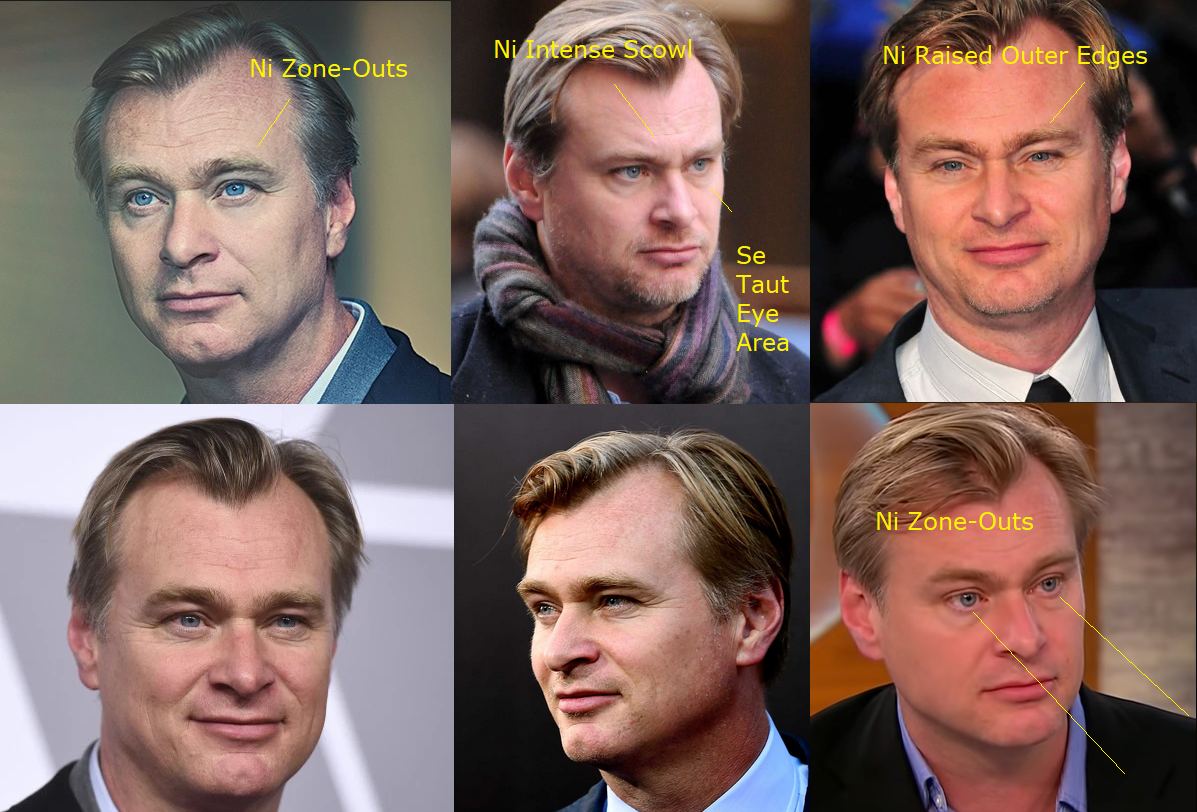
One of the first things that struck me about the video of choice is the low resolution, which is specifically damaging around the eyes. I felt I was seeing Fe+Ni from the video, which runs counter to the Fe+Si consensus so I double-checked. The best way to do this is to look at the highest resolution photos possible, even still images, and it's my habit to form a collage like so:

^ He appears to have Ni Zone-Outs, Ni Intense Scowls, Ni Raised Outer Edges, Se Taut Eye Area and in a dynamic sense he also appears to have Ni Grounded Inertia.
Looking at a higher resolution video, I found this one:
And we see that this Ni ocular tension is present here as well. I agree with Fe though, as that seems to be the lead process, although he does have considerable introversion.
He is similar to the FeNi ll-- samples (link) in the OP, although in this particular video above I think he's showing up as FeNi ll-l (double-introverted). We can see his similarities to FeNi ll-l Carl Sagan here:
So in summary it seems consensus estimate was: FeSi ll-- (alt SiFe ll--)
And mine is: FeNi ll-- (in the OP video, and modulating to FeNi ll-l in other videos)
That's actually not too bad! (by the way I can explain the details of my estimate in more detail if there's any questions, please feel free to ask?)
It'd be really neat to see which Si signals were selected though, since almost everyone had strong Si in their tally -- so I can know where the confusion is. (I think signal-specific results would be great to have, essentially making the App a kind of virtual tally sheet like the one I give in the reports
)
Apparently, Ni and Si are very hard to distinguish (at least without finished signal descriptions).
@auburn: "It’d be really neat to see which Si signals were selected though, since almost everyone had strong Si in their tally — so I can know where the confusion is."
-dulled eyes, as they generally looked bored (Ti influence?)
-confused stare, when he was confused by the drawing on the board
-concerned concentration, as he is very serious (general Pi signal?)
-dancing brow, very animated brows (Fe influence?)
-anecdotal rambles, like the car ride with his brother
-indented sockets, since his eyes are quite closed (general Pi signal?)
-concerned eye-drifting, as his eye-drifts are short and near
-silly-serious, as playful moments are very short (general Pi signal?)
The signals that I saw for Si were mainly the intense rambling (as Sander mentions the story with the car) which at times I thought didn’t correlate to anything he was saying before or after, and the drawing on the board looked like what I would expect from someone with Ne. I also searched for pictures, too, and to me the eyes didn’t look as intense and frankly I still perceive them as soft.
I wasn't really able to decide between FeSi or FeNi (with Ti-developed). I forced myself to use only this video and the CT Reader to not mess up with the data. But using only one video, is not always optimal, imo... And the CT Reader doesn't take into account the development levels/functions' energetics (I got 61% for FeSi, followed by both TiNe and FeNi at 53% - and I wasn't thinking Ti-lead at all for him) - not complaining: it's a good tool to keep in mind all the signals when typing somebody.
The eye area seemed taut, indeed... But some of his ocular and eyebrow movements were a bit confusing… In this particular video, at least (in a real situation - without being constrained by the test's standardisation - i would probably search for more data before sending an answer).
That's pretty close to me, especially that we got the development levels correct too for the video (and noticed the potential for eventual development in his Ji, Ti). The third highest percentage was FeNi at 41%.
I definitely found one Si signal (concerned concentration, I think), but I saw mostly Ni in my assessment. The eye-head Se parallel motion was obvious to me, and the Ni zone outs, and the taut eye area and pointed eye toggling.
Imagine multiplying the contribution by 10, so that 50 results (50 sets of eyes) or even 100, are triangulated and averaged. My prediction is that more people would notice the Ni signals that we missed (hence more accurate).
Also, imagine making the Reading App a more user-friendly tool: have 5 signals at a time, hovering GIFs for each signal, and automatically triangulated results after every independent reading.
@sander - Roger that!
The signal pages definitely need completion and that's my shortcoming. For the time being I've made 8 videos covering the 80 function signals in this thread here -- which can serve as primers. Here are videos of both all the Si and Ni signals to compare:
In CT the phrases like "confused stare" and "dulled eyes" are technical terms referring to very specific physical features -- so that their definitions differ from the typical nomenclature. The names are in some sense just labels used as shorthand for the visual aspects.
-dulled eyes, as they generally looked bored (Ti influence?)
So dulled eyes doesn't refer to boredom (boredom is actually more of an Ni signal, as a variant of "unimpressed" eyes). Dulled refers to a doe-eyed blank stare similar to this:

^ Si Dulled/Doe Eyes
^ I may just re-title this signal Doe-eyes, as that's been on my mind for a while now and it makes for a less confusing terminology.
-confused stare, when he was confused by the drawing on the board
I can't find the exact timestamp of this, do you think you could point me to it? But In general, anyone can be confused. Being confused is not the same thing as the CT signal.
-concerned concentration, as he is very serious (general Pi signal?)
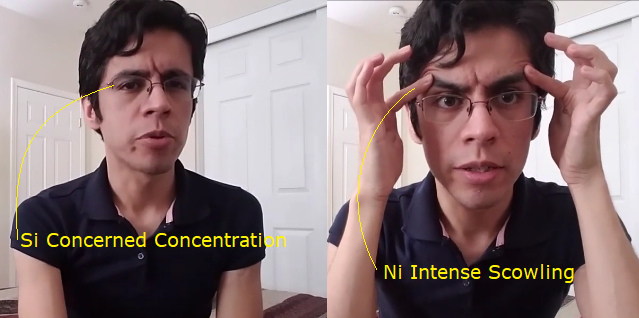
Pi-5: Searching Scowling is a general Pi signal yes, and it differentiates into Si and Ni based on the shape of the brow. So we gotta look at that. Here's a still shot compilation from the two videos above:

-dancing brow, very animated brows (Fe influence?)
No no, I think you totally missed it.
Going off the signal names (and what they sound like) alone is a bad idea. You gotta see the signal itself in some examples. Again sorry for not having more data on this but is what it looks like:

^ Si Dancing Brow
-anecdotal rambles, like the car ride with his brother
This could be a check for Si, yeah. Ni users are not incapable of recalling memories but the structure of the code would require this being a mark for Si which is fine since the confirmation of Si would come from a wider spectrum of signals being visible. 🙂
-indented sockets, since his eyes are quite closed (general Pi signal?)
I'm not sure what you mean by this, but if by eyes "closed" you mean narrowed/squinted, that would be Ni. We actually do have this one in the code pages as:

-concerned eye-drifting, as his eye-drifts are short and near
I'm not sure what's meant by short and near here, but I hope the video above answers this question better. Lemmy know if there's still confusion.
-silly-serious, as playful moments are very short (general Pi signal?)
Again I hope the videos above answer this one. 🙂
Got the code working. Here are the results. These are the odds of getting the results we got or stronger by chance. A statistically significant result is less than .05.
J-Lead/P-Lead: .6718 (Insignificant)
Conductor/Revisor: .0120 (Significant)
SeNi/NeSi: .00084507 (Significant)
TeFi/FeTi: .000049730 (Significant)
Possible Types: FeSi or SiFe
This is a very interesting project! I didnt discover it before now.
I would guess that the experiment must be inspired by the experiment that Francis Galton did - Wisdom of the Crowd?
Take a look at this wiki: https://en.wikipedia.org/wiki/The_Wisdom_of_Crowds
My friend has done a lot of experiments like this with hundreds of people guessing the amount of corn flakes in a big glass jar. People give their wild guesses, some say 200, some say 5000. But the average of the guesses are very, very close to the actual amount, and what is strange is that the average is always more correct than the closest guess.
I hope you will make yet another experiment like this, Scientiam. The amount of people participating this time was far too few for the 'Galton effect' to show up. I dont know how many is needed for the wisdom of the crowd is beginning to be seen, I can ask my friend if you want me to.
Hey Sekundaer,
The project was inspired from a segment on "Brain Games" show where people had to guess how many gumballs where in a gumball machine, and the average guess was the most accurate to the actual number. I'm pretty sure the segment was inspired by "Galton effect."
Yes it was only a few people, but the guess was actually pretty close: most likely FeSi, SiFe (where his type was FeNi as typed by Auburn), with more people I am pretty sure that we would have typed Christoper Nolan correctly. I think there was also a problem with the fact that the Si vultology code signals GIFs where missing or the signal had no description apart from the name, and so the participants assigned signals to Si based on just the name of the signal, like Si "concerned concentration" for example.
The project currently stands at being able to get GIFs and descriptions for all the vultology code signals and a revised CT Reading App that is more user friendly, shows the GIFs for each signal, and that is able to calculate the averages of multiple typings on the same video/person. Part of this stuff is in the CT Drawing Board that Auburn created so the community could contribute their support, and I definitely will dedicate some time to the GIFS (if I had more coding experience I would also help revise the Reading App, but I don't have any knowledge of it currently).
Once this is finished, we can continue with the project and I have members of family as participants to be typed. I think this is a very important project because it proves the objectivity of the signals and signal clusters and therefore of type.
Also, yes, if your friend knows anything about CT and how it types people, I would very much like to know what he thinks is the minimum amount of people that would be needed for the "Galton Effect" to show up in general and in "collective typing", that would be much appreciated ☺️.
Hi Scientiam,
I just realized there is a big difference between Galtons/Brain games experiment and this one.
Galton asked people to guess the weight of a cow.If we say that the app will at some time contain all the gifs with signals as well defined as Kilograms/pounds are well defined measures, it is still different from the Galton experiment as in his experiment people were free to make guesses as far out as they wanted to both sides . Whereas in this experiment there is a limit. Say a person has 8 signals for his dominant function, then you can only err 2 to the one side (by marking 10 signals), but its possible to make a very big error to the other side (by marking zero signals), like it happened in this trial. This will of course influence the average score, so that even if 1000 people were participating, the crowd as a whole would necessary land on an average score much less than the correct one.
Since we will probably never be a 'crowd' of people in the experiment, it might not be of so much importance. But still I think it might be worth to consider letting a deviation of +2 count as much more than a deviation of -2 in the above example, if you get what I mean.
I think I understand what you mean, though I'm not sure: is it letting signals that are positive (that are marked) be valued more than signals which are not marked?
I think each individual signal, rather than a cluster of signals, is it's own "gumball machine" or "cow," and the value is only whether that signal is there or not (basically asking if whether there is or is not a "cow" or "gumball machine" here in front of you ). Therefore the average response of positive or negative of just one signal should give an accurate result as to whether that signal is there or not (and therefore not strictly a "guess" on scale as in the Galton experiment). The reading app gives structure because it combines all the results of each individual signal (every yes/no to each signal) under groups and subgroups, which the "crowd" doesn't have to know about (for example, J v P> Ji vs Je > Fi vs Ti). The reading app also has internal rules, principles that the crowd doesn't know of either, like the fact that having multiple signals of Fi doesn't mean you have Fi conscious.
So yes, although inspired by it, this method is not about average guessing on a scale of measurement, but on fundamentally seeing whether one objective unit is "on" or "off," which should be pretty easy once we define what the unit is. The consistent structure, rules and formula of the reading app (or the reading process) does the rest to determine the person's probable type based on the results of each signal. And I think your suggestion deals more with the "rules" or "formula" aspect of the reading app. I think we could try your suggestion on some trials, once the project starts again.
I'm not sure this make sense, so please let me know if it does not so I can try to articulate it better.
Hi again, you have formulated it perfectly clear, so I understand you now. It sounds like a very good idea to let it be about a 'yes' or 'no' to each signal.
But this was not the idea I got looking at the 'spoilers' in the thread where people had just reported how many signals per each function they had found, but not which signals. But if each marked signal will be reported from the participants what I wrote is irrelevant.
There is an interesting site that is inspired by Galton and uses yes/no responses instead of scaled answers. Instead of guessing the weight of a cow, 'the crowd' makes guesses about the future (but people are not unbiased about the future, so I guess it should be taken more as entertainment)
https://futuur.com/
I don't think the code I submitted last time was correct, but I think this iteration is.
Once again, these are the odds of getting the results we got or stronger by chance. A statistically significant result is usually anything less than .05.
J-Lead/P-Lead: .033
Conductor/Revisor: .012
SeNi/NeSi: .001
TeFi/FeTi: >.001
Likely type: SiFe
I'm not great at the tedium of checking every signal, but he looks FeNi.
.
.
.