FeSi Profiles
FeNi Profiles
TeNi Profiles
TeSi Profiles
NeTi Profiles
SeTi Profiles
SeFi Profiles
NeFi Profiles
TiNe Profiles
TiSe Profiles
FiSe Profiles
FiNe Profiles
SiFe Profiles
NiFe Profiles
NiTe Profiles
SiTe Profiles
Current State of Typology

Home 2023 › Forums › Official & Introductions › Current State of Typology

Viewing 8 posts - 1 through 8 (of 8 total)
  • Author
    Posts
  • #9608
    Juan E. Sandoval
    Keymaster
    • Type: TiNe
    • Development: l--l
    • Attitude: Adaptive

    I've briefly touched on this topic in other threads, but I find it important to give a more elaborate view on the landscape, according to my current understanding of it. If anyone more initiated on these topics would like to offer updates, feel free to comment.

    Psychometrics

    The most compelling evidence existing to date for personality variations appears to come from the NEO PI-R (Five Factor Model (FFM) or Big Five). These categories are:

    • Openness to experience (inventive/curious vs. consistent/cautious)
    • Conscientiousness (efficient/organized vs. easy-going/careless)
    • Extraversion (outgoing/energetic vs. solitary/reserved)
    • Agreeableness (friendly/compassionate vs. challenging/detached)
    • Neuroticism (sensitive/nervous vs. secure/confident)

    I'm not a personal fan of psychometrics but the FFM is doing a lot right, as far as approaching the question of personality with rigor and consistency.
    Highlights Include:

    • Atheoretically Derived, Data-Driven Model: Extracted from a factor analysis, using adjective groupings, repeatable across different countries.
    • Internal Consistency: The terms used to describe the facets beneath them have a high Cronbach's alpha value ( .89 to .93). That means the survey questions converge in what they measure.
    • Retesting Validity: Scores appear to be consistent across re-resting, I've seen statistics quoted at "r = 0.70" and "ρtt = .816" which are great numbers for anything in the field of personality research.

    So if someone were looking for a reliable, evidence-driven, scientifically-supported psychometric, the FFM would be the place to put your money. In any event, since it is data-driven, these results must be explicable by any other model that tries to do what it is doing, or exists in an adjacent domain.

    Myers-Briggs Type Indicator

    Now most of us here came from the MBTI rather than the FFM, so how does the MBTI fair in this field? Well there are two parts to this answer:
    Jungian Cognitive Functions MBTI ("JCF")
    The MBTI fails falsifiability and repeatability tests miserably when it tries to apply cognitive functions theory. And it performs much better when functions theory is removed, and it is treated as 4 letter dichotomies. The hypotheses such as function order (Xi-Xe-Xi-Xe) came out false, and function exclusion was not detected either. To summarize Reynierse:

    The empirical problem for type dynamics is a systemic one, as there is no consistent structure present in the data. Whatever model of type dynamics was examined—the Grant-Brownsword, Manual, or Beebe model—the results were the same: Specific predictions were not confirmed, and contradictory reversals occurred often. Further, there is a good reason for these systemic empirical problems: Type dynamics is confounded with its MBTI content such that the expression of the functions in the extraverted or introverted attitudes reverses E and I conditions and thereby produces systematic bias that distorts strict MBTI empirical relationships. Type dynamics, in any form, simply does not organize the data in an orderly fashion that corresponds with the facts. Type dynamics is a conceptually muddled construct that lacks coherence.

    For those who may have run into the member Reckful on other forums such as INTJforum, you may be familiar with his vocalizations of this point. He's done a far better job than I could at explaining this so I'll link a few of his posts here but it's easy to find his others:

    In the scientific community, the 8-functions are seen as a rationalization with no true support. And it's no wonder. This is precisely why I make note of the risks of reverse-engineering functions after learning about the code. So if you're stuck between INFP and INFJ, the answer is not actually to be found in studying Fi-vs-Fe and Ni-vs-Ne. An INFP will often test high in Fi but also in Ni and Ne, so there is no mutual exclusion there between Ni and Ne as defined in their literature. At least that's what the data shows. So more confusion would come of it, and flip-flopping of type due to reinterpretation.
    By contrast, for example, the dichotomies (N/S/T/F/I/E) remain a little more stable, so being I+N+F+[ P ] may be more solid grounds than whatever we may try to say about what's "under the hood" in terms of which functions make up the type.
    Standard  MBTI
    Now, I should mention though, that the standard MBTI's reliability is still rather poor. It appears to be able to establish greater credence by its tangential relationship to the FFM (link). So the MBTI has some legitimacy by proxy of how it correlates significantly to the FFM/Big-Five. We might say the MBTI is the poor man's Big Five. And this is precisely why people like Jordan Peterson go for the FFM and not the MBTI (link). The correlations are roughly as follows:

    • Openness to experience (N vs S)
    • Conscientiousness (J vs P)
    • Extraversion (E vs I)
    • Agreeableness (F vs T)
    • Neuroticism (N/A)

    Theory of Mind (Information Models)

    Now, if all we are trying to do is classify human traits, then the FFM/Big-Five is just fine. But where the FFM falls short is in a complete lack of a theory of mind. It is not a description of "how we think" or of cognition more generally, it's strictly behavioral and I would argue it's behaviorism done rather cleanly. However, it remains rather bland as an explanation of the psyche, and also says nothing about where these qualities come from. It appears to me as an emergent effect, while the cause remains unknown.
    By contrast, metabolic processing models like Socionics and CT offer explanations about the "why" and more sophisticated dynamics. We have function axes (Ti/Fe, Fi/Te, Ni/Se, Ne/Si), quadrants (Alpha / Beta / Delta / Gamma), energetics (Pe / Ji / Pe / Pi) that appear to line up with reality on an intuitive level in a way that trait theories can't account for. But again information models are susceptible to circularity and over-reliance on mathematical elegance -- rarely checking their assumptions with falsifiabilty tests.
    Socionics
    Socionics is in the same slump as JCF. It has no consensus among its experts and thus no standardized methodology. As far as I can tell it hasn't been rigorously tested, to show whether their dichotomies are mutually exclusive in the way they predict. The most ambitious effort I've seen towards this direction as of late comes from Andrew Joynton in his PDF:
    https://drive.google.com/file/d/0B63Di60mz5DZOFZ5eElZa0REOGs/view
    His view for possibly gathering evidence can be summed up in:

    The internal consistency of dichotomy measurements can also validate or falsify a specific test. Even if good reliable definitions for each dichotomy are created, there still needs to be a way for a subject to fail the evaluation.

    He essentially proposes that we use very precise, consensual definitions of each of the Reinin dichotomies to gauge type. His argument is that the Reinin dichotomies are the most reliable as they have elegant internal consistency and are already posited as polarities and thus allows us to test mutual exclusions. He states that the possible combinations are 33,000 but only 16 combinations are postulated by the mathematics of Socionics. Thus, if people do actually cluster around the math of the Reinin dichotomies, that would verify the reality of Socionics.
    Hypothetically, this would allow for an avenue of validation through triangulation of traits. So for example an IN_p "type that is farsighted, tactical and decisive must also be dynamic, intuitive, introverted and irrational." (emphasis added) I look forward to seeing if any such studies are performed, although I have my reservations regarding its probable success.
    (more later)
     

    #9614
    Supah Protist
    Participant
    • Type: SeTi
    • Development: ll-l
    • Attitude: Directive

    Cybernetic big five theory tries to offer a theory of mind based on the big five, here’s a paper on it: https://scottbarrykaufman.com/wp-content/uploads/2014/08/DeYoung-2014-CB5T-JRP.pdf

    #9623
    Juan E. Sandoval
    Keymaster
    • Type: TiNe
    • Development: l--l
    • Attitude: Adaptive

    @supahprotist - Oh I like what DeYoung is doing! He gets it; the need to focus on metabolism (he calls it "cybernetics"). And what I call information processing he calls "mechanics." But he's describing the same exact thing. I've only read the first couple pages but will be sure to read the rest to see what he says more completely.

    #9626
    Juan E. Sandoval
    Keymaster
    • Type: TiNe
    • Development: l--l
    • Attitude: Adaptive

    Oh! This guy (Colin G. DeYoung) is a student who worked right under Jordan Peterson -- that makes sense. This is him holding Jung's Red Book:

    Spoiler

    [collapse]

    I've skimmed through most of the paper now and I have a few notes about it:

    Notes on Metabolism & FFM

    A few problems I have with the initial approach of using the FFM to then peer beneath towards metabolism is that -- do normal people really know what fundamental dynamics constitute the construction of their awareness?
    When we consider that the FFM is, in the end, merely statistically correlating adjectives and personality traits together that people use to describe one another, it fundamentally relies on human language and interpersonal comparisons (I like DeYoung's use of this word) of average qualities. So it measures how much of [ x ] behavior you show, according to the norm, and also what behaviors people tend to describe as a collective body. This is fine and all, but that approach has fundamental limits.
    You wouldn't survey average people to try to find out what the lobes of the brain look like. They'd have no way of knowing that. Likewise, whatever mechanics are producing those behavioral effects (Big Five) may be of an entirely different construction than the end products generated -- due to emergence.
    So to use an analogy, a ecologist can identify different environmental features in broad strokes (swamps, hills, forests, lakes) but that says little about the molecular constitution of the soil and what the environment is made of. It would be relatively simple to get a few thousand people to come to a consensus about what ecological features are most classical and which define the widest range of worldly features. A typology can even be developed along the lines of Five Factors (i.e. Forests, Deserts, Water Sources, Grasslands, Rocky Lands).
    Factor analysis of words can find adjective clusterings across things like Forests (sub-traits: trees, leaves, insects, shade, etc). But is that at all describing the mineral properties of the location? In some sense, we might say "red sand" has a lot of iron content but without a knowledge of chemistry or the proper instruments to measure iron, this is not verifiable. All we see is red.
    I see the Big Five being somewhat similar or at least in an analogous situation to the deeper mind. The human-based grouping and polling of descriptive adjectives across the world --however consistent it may be-- doesn't necessarily reflect cognitive processing as may be happening at the neurological or computational level. In my metaphor Factor Analysis is the clustering of ecological systems into forests/deserts/etc, and neuroscience is the molecular understanding.
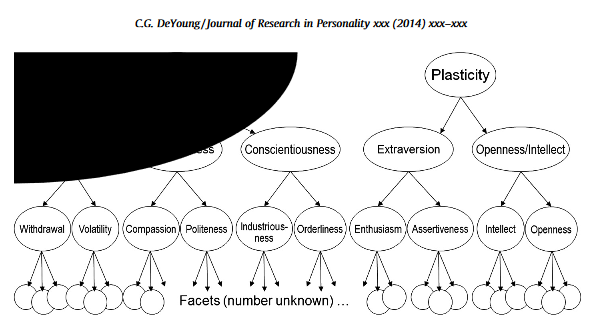
    DeYoung seems to be trying to work backwards from the factor analysis to the "molecules" by getting more granular with the adjectives/traits that people use to describe themselves -- using a branching tree:

    This seems to me to be somewhat misguided; like trying to separate out materials based on color. So imagine trying to discover the periodic table by first grouping sands together via colors and then classifying them by those colors and perhaps by sub-shades of color. It's just not how the periodic table is arranged or grouped:

    There is actually a better analogy to this: alchemy. Way back in alchemy the four categories that made up the world were seen as: Earth, Air, Water, Fire. In a sense these can be translated as: Solids, Gases, Liquids, Plasmas. And that's true in a way, but those categories aren't atomic categories.
    So again we could perform a factor analysis study on prehistoric people and get a wide consensus that the broadest categories of the world were solids/gases/liquids/plasma. We can then sub-divide solids and liquids, and so on.
    But some molecules are liquids or solids depending on the construction of atomic bonds. The fundamental categories aren't solids/liquids/gases/plasma -- those are states.
    So in this analogy, the states are the Big Five. And so to follow the metaphor here, the Big Five factors are real in the same sense that states of matter are real, but they are not the same thing as chemistry. And the division between states of matter and chemistry is sufficiently large, that a new toolset (instrument) is needed to make the connection.
    This is just my takeaway from the paper, but it's interesting and exciting to see efforts being directed towards this more mechanistic understanding.

    Final note:

    I would be more inclined to believe a methodology that begins from the other end, with neuroscience. Perhaps we can begin with Iain McGilchrist's left/right brain divisions  and working more granularity from there by identifying globalized sub-systems, or what's been described as "neural cliques" by some. DeYoung's concepts of systemic "goals" could be mapped also by the processing goals that each "hemisphere" (it's not entirely literal) has.
    I might imagine that a neural clique designed for exploration/experimentation (Pe) could be identified, and a pragmatic-actionable neural clique (of Je) as well. It may not even be that hard if we strap brain caps on people as they perform designated tasks to see if certain clusters of tasks are linked across a wider circuit.
    For example, if we see a similar circuit (or family of circuits) used for possibility generation, exploration and seeking out stimuli -- then we can identify that there is a larger "function" happening that is activated across all three cases.

    #9627
    Rua
    Moderator
    • Type: NeTi
    • Development: ll-l
    • Attitude: Adaptive

    I have a few thoughts on this. The first is that like many I was glad that personality psychology finally had something to cling to statistically in the Big Five, as psychology never can or will be valued as a science until it can speak without reference to the subjective (psychology must do more than this, but it must be able to exist in this objective domain as well). And while the internal consistency of the Big Five is undeniable, its applicability and possibilities for a further understanding of the mind always seemed very limited. I would also not be surprised to find its test-retest reliability has been overstated, and we could argue this from a CT system's perspective I think.
    If we assume the CT system to be true, and that an individual can change from a conscious manifestation of  double introversion, let's say Fi-Ni (with their counterparts unconscious), to that same individual three years later manifesting conscious Te-Se (with their counterparts unconscious), then I suspect this individual would at the very least have markedly different scores on the Extraversion portion of their Big Five assessments. My point being that the Big Five is likely not the individually stable system of personality it has often been marketed as; its stability is likely the most strong at the population level and within time spans that are not truly reflective of the length of individual growth (years/decades) due to research restraints and practicality.
    The reason why the CT system is more promising in my mind than the Big Five (or Socionics, though I admit my knowledge is very limited in that domain) is two-fold. The first and major advantage CT has is that its manifestations can be directly observed, and while the sophistication and precision of our measurements is currently lacking, that is not a systemic problem; greater precision and sophistication will inevitably arise with advancements in neuro-imaging and facial-cranial technology. So, this is its first and major strength, it is observable and it is falsifiable once the signals have been thoroughly scrubbed.
    Its second major strength is its focus on process over content. Process vs content, and the ensuing muddled mess that becomes of most typologies, is extremely prevalent in the field. When you give someone the skeleton of a system and say "Trust me there's organs in there", they will fill in the meat of the project on their own, with widely subjective, unconsciously biased results that feed into the brain's proclivity to overgeneralize in the absence of specifics. CT has avoided this by clearly delineating its processes and divorcing them from specific contents.
    As a side note, the recent thread on the Fe Hero Myth has been quite interesting. I very much think Auburn is correct in the track he is taking here (I think the word "Hero" derailed things a bit). What I mean is that I think that what connects various individuals of the same type is not the similarities or differences in the specifics of their lives (though these could overlap to a large degree), but that the path they are following shares structural similarities to the paths of others of their type, and would be structurally dissimilar to that of another type (possibly correlating directly with how many functions are shared between the two). We might test this narratively across populations, and upon thinking of it this must partly be Auburn's aim through the forum and Discord, to elicit these type narratives and see how they stack up. Types from widely different cultures and geographical regions having narrative similarity to each other when asked to describe "their life's journey" [or something], while also having dissimilarity from the narratives exposited by other types would be the golden egg, but this would seem a very difficult goal to achieve in practice. Having recently read Robert Sapolsky's Behave, which cites a fair amount of individualist vs. collectivist cultural differences, perhaps I am being too pessimistic here 🙂

    #9631
    Supah Protist
    Participant
    • Type: SeTi
    • Development: ll-l
    • Attitude: Directive

    I’m not sure DeYoung is positing that people are knowledgeable of their own cybernetic parameters, to the best of my knowledge he’s basing his connections between big five traits and cybernetics off of the neuroscience.
    Here’s one of his papers on personality neuroscience:
    https://drive.google.com/open?id=0B-XDPUhSKUmOaUpuT052ZmkwZUU
    He made connections between the brain regions that were associated with each of the big five traits and cybernetic parameters. In the first paper I linked, I think he cites neuroscience studies that back up his conclusions.
    Just wanted to provide some clarification.

    #9665
    Juan E. Sandoval
    Keymaster
    • Type: TiNe
    • Development: l--l
    • Attitude: Adaptive

    @rondo - Yes. Not only does the Big Five not provide any comprehensive theory of mind, but it also seems to posit these traits as "mostly stable" across life, yet not necessarily so. In contrast, CT measures something which appears to be intrinsic even across twins and decades -  while accounting for shifts in development, yet remaining the same type.
    But what's the real bummer for me is the foundation itself being based on a statistical factor analysis of adjectives/language. I think this is simply the wrong bedrock to work from. You can only go so far with that. It's already "non-central" from the start. It's a description of patterns in trait clusterings, so it's a side effect of something else... yet unknown. That unknown thing is the actual theory that gives rise to Big Five, so Big Five sits atop of something more mechanistic.
    In this way it's almost gone full circle, and it seems Big Five plays the role of the (4) letter-code but with more careful boundaries, and DeYoung appears to be looking for the "functions" that create that 5-letter-code. But I don't think he'll find it there because the phenomenon is coming from a different place.

    #26493
    DudeMan
    Participant
    • Type: Unknown
    • Development:
    • Attitude: Unknown

    "As far as I can tell it hasn’t been rigorously tested, to show whether their dichotomies are mutually exclusive in the way they predict."
    It has been done, but I cannot judge whether his methodology is "rigorous" or not.
    http://sociotoday.narod.ru/funkcii1.html
    Note that it is all written in Russian, here an excerpt from a google-translation:
    "If we define the properties of all 8 functions in their programmatic and creative positions in the above way, and then calculate these properties quantitatively, starting from the known properties of psychotypes, and then bring all these properties into tables, then we can further compare these properties with each other - for example, calculating linear correlation coefficients between all functions (8 software and 8 creative). Based on the material of 2300 generalized psychological properties, calculating the correlations between the loads for these properties of all 16 functions, we did the following work, and here are the intercorrelation matrices that we received as a result (Tables 1.1. And 1.2.)"
    "Programmatic" and "Software" refer to the first/dominant function here
    "B" most often refers to "Byelo-" meaning white, denoting an introverted function. BI=Ni, BS=Si, BL=Ti, BE=Fi
    "OR" = Ne, "Emergency" and "World Cup" = Se, "ART" or "ЧЛ" = Te, "CHE" or "ЧЕ" = Fe
    ILI might also be translated as "OR", ESE as "ESS", EIE and IEE as "YES" and LSE as "FEL"

Viewing 8 posts - 1 through 8 (of 8 total)
  • You must be logged in to reply to this topic.
bookmarkglobeenvelopeshopping-bag