FeSi Profiles
FeNi Profiles
TeNi Profiles
TeSi Profiles
NeTi Profiles
SeTi Profiles
SeFi Profiles
NeFi Profiles
TiNe Profiles
TiSe Profiles
FiSe Profiles
FiNe Profiles
SiFe Profiles
NiFe Profiles
NiTe Profiles
SiTe Profiles
Database Additions

Home 2023 › Forums › Vultology & Learning Center › Database Additions

Viewing 12 posts - 1 through 12 (of 12 total)
  • Author
    Posts
  • #15481
    Juan E. Sandoval
    Keymaster
    • Type: TiNe
    • Development: l--l
    • Attitude: Adaptive

    Now that the development levels series is generally complete, new additions to the database will be recorded in this thread as they arise.
    Some previous celebs haven't yet been added, and there are plenty more new people to add - so I hope to make additions a regular thing. Feel free to comment on any samples here, and if a sufficient discussion develops, we can always thread-split.

    #15482
    Juan E. Sandoval
    Keymaster
    • Type: TiNe
    • Development: l--l
    • Attitude: Adaptive

    SiFe l--- Adaptive Female - Mary Douglas

    Spoiler

    [collapse]

    The first female SiFe to be added to the new database!
    Mary Douglas' psychology is surprisingly in concert with the pattern established in the SiFe thread with the male academics, in focusing plenty on psychology and cognition - specifically as it relates to the human condition, society and so forth. To transcribe the above video, as best as I can manage...

    I was much too interested in cognition, as something that was supported by behavior. And that reflected behavior, so there's cognition and society; a kind of intellectual background to put in danger. The mind has a lot of discomfort from seeing things that don't fit the categories that people are using for thinking about them. And this was very [Drogenheimen?] and Mercian. And I pushed that idea so far through the book that I left out the central message in the book which was that social life makes the categories.
    And so at the time, without even completing the book, when I read Leviticus I treated the forbidden foods in Leviticus as cognitive categories. Good to think with, yes, which is my great reproach against [lady Strauss?] y'see. Whereas they should have been good for interacting with other people and making an understanding of why we're interacting and what we're doing - and therefore the "action" part should have been much more to the fore, and it was in the book, but nobody took it out because they liked that chapter, the cognitive one, best.

    What we see here are echoes of Pi philosophy, but also a very Alpha-like narration of the human-condition as seen from above (so to speak). She is not too different from the NiFe samples, and indeed the parallels between the NiFe and SiFe samples only continues to grow.
    The section included in the video above is one in which she speaks about many Fe topics, such as the matter of social interactions, human cognition as primed for them, and so forth. Other videos by her also show plenty of anecdotal narration, and the rather compartmentalized and sequential Si structure of information synthesis.
    But to tease out just a few phrases, as I cannot manage a complete dissection of her approach:

    Spoiler

    The mind has a lot of discomfort from seeing things that don't fit the categories (Si) that people (Fe) are using for thinking about them

    Echoes of instrumentalist beliefs (Fe), and the necessity for schema (Pi)...

    ...that social life (Fe) makes the categories (Si)

    Fe+Si value/priority, societal environment is seen as the source, in some sense, for the cognitive end-product of the subject.

    [collapse]
    #15488
    Juan E. Sandoval
    Keymaster
    • Type: TiNe
    • Development: l--l
    • Attitude: Adaptive

    SiFe l--- Directive Male - Richard Schechner

    Spoiler

    [collapse]

    Here we see another SiFe sample talking, very similarly, about the relevance of the intersection between behavior and the social life. To quote some of the above:

    ...very interesting words; Liminal & Liminoid. They can be traced back to the writings of a french anthropologist Arnold Van Gennep who in 1909 wrote "les rites de passage", the rights of passage. In this book, Van Gennep says that all rights - and especially initiation rights; rights of passage - from puberty to adulthood, from having power to giving up power, from death to funeral rights to after-life... had three phases: separation, the middle or liminal phase, and reintegration. This work deeply influenced Victor Turner (...)
    Ritual is a way of organizing and reorganizing behavior into set patterns. It is a way of taking certain behaviors and emphasizing them, and making new things from old behaviors. For example, to use an animal example...

    Notice how there is a focus on the narrative (Si) of the individual, as informed by social life (Fe) and enacted behaviors (Fe) which have in them embedded beliefs. The full video goes into much more detail about how the enacted ritual has power on the individual. And here we see the traces of Fe+Si information metabolism.

    #15504
    Juan E. Sandoval
    Keymaster
    • Type: TiNe
    • Development: l--l
    • Attitude: Adaptive

    SiFe ll-l Directive Male - Fredrik Barth

    Spoiler

    [collapse]

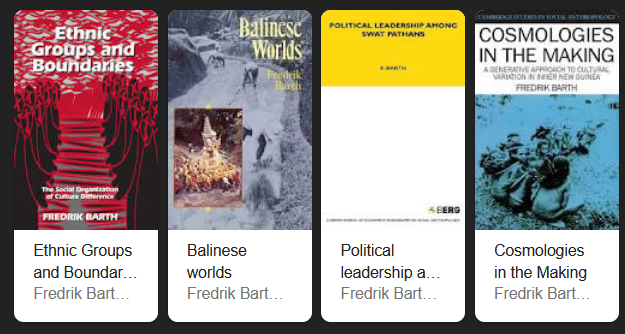
    I also came across this famous social anthropologist SiFe man, who discusses a similar range of topics and who appears to be regarded as a central thinker in academic/anthropological circles from what I can tell? Here are some of his books:

    And the Google Books summaries of the first two:

    "Ethnic Groups and Boundaries: This classic is regarded as the seminal text from which stems much current anthropological thinking about ethnicity. This text opens with Barth's invaluable thirty-page essay that introduces readers to important theoretical issues in the analysis of ethnic groups."
    "Balinese Worlds: In Balinese Worlds, Fredrik Barth proposes a new model for anthropological analysis of complex civilizations that is based on a fresh, synthetic account of culture and society in North Bali and one that takes full notice of individual creativity in shaping the contours of this dynamic culture"

    We see again an analysis of social groups, culture and in this case ethnicities. The Si+Fe pairing appears to, again and again, focus on an analysis of culture/society from a human-nature point of view (Fe), with emphasis on the specific categories (of thought) that form the particular (Si anecdotal) groups.
    In the interview above, we mostly only hear an Si anecdotal ramble about his past, but other interviews of him are more informative about his theories, for those interested.

    #15506
    Juan E. Sandoval
    Keymaster
    • Type: TiNe
    • Development: l--l
    • Attitude: Adaptive

    FeSi II-I Adaptive Female - Byron Katie

    Spoiler

    [collapse]

    This sample is particularly fascinating to me. She is a double-introverted FeSi with a spirituality informed by her Ti in much the same way we saw with Jordan Peterson in this thread (link) where he talks about the coming of Ti into his consciousness.
    To quote some parts of the video above:

    ...for the first time I could see but it wasn't a visual thing, and it was a visual thing. I could see without narration, I could see without thought or name or word. And it was a very sweet experience, and it continues. But inside of me ...y'know I travel the world asking poor questions and inviting the people to turn it around. What happened was, whatever would arise... there was no way for it to stick or have meaning. A thought, like "my husband should care about me", "my children should respect me more", or even "the sky is blue." It was just, internally, I could see it all as a story - so there was a lot of laughter. What I experienced mainly was laughter.
    Now, learning to speak fluid.. it becomes more fluid with each day probably. But it was broken, it was in the moment, it was not easily understood to the ear or the intellect. But it was perfectly understandable to the heart. (...) We could say this is a rose, yes, and I would ask you "is it true? can you really know that that's true? who ever told you such a thing?" - and that's the thing, to know for yourself.

    This is the myth of Alin in full effect.
    What we hear above is a description of her going mute, essentially momentum clamping the articulator (Je) so heavily through Ji's implicit (pre-verbal, essentialist) ontological understanding of things that all language representation is seen as void.

    Now, learning to speak fluid.. it becomes more fluid with each day probably. But it was broken, it was in the moment, it was not easily understood to the ear or the intellect.

    As was stated in the linked thread, in Fe types, Ti is the regulator of rhetoric. We see in the above quote echoes of Ti reductionism, Ti ontology and Ti perfection. But we also see echoes of zen release from boundedness-by-form/word. In the full interview she elaborates more on how she still "acts" as thought she has personal preferences, but exists at a detached distance from them and even her own bodily choices. And there is a sweet release felt from this lack of attachment as it lets go of the suffering that otherwise comes from dualizing and splintering reality into positive/negative, right/wrong, respected/disrespected, cared-for/un-cared-for.
    I really could dissect this video for hours, but I hope this is enough to prompt those interested to watch the full interview (starting at 10:00 here).

    #15510
    Juan E. Sandoval
    Keymaster
    • Type: TiNe
    • Development: l--l
    • Attitude: Adaptive

    NiFe II-- Directive Female - Tamar Ross

    Spoiler

    [collapse]

    Now we veer to a different quadrant, with NiFe Tamar Ross. In the above passage we see her discussing works that are not her own thoughts, but nonetheless are the sort of thoughts that preoccupy her attention and focus. They deal, as with other NiFe's in the data, with the hard problems of consciousness, the definition of God, of reality and metaphysics.
    She follows in the same pattern as other NiFe (or Ni+Fe more generally) metaphysical philosophers that we've seen such as NiFe Humberto Maturana, NiFe Carl Jung, FeNi Francisco Varela, and Martin Heidegger.
    Placing her besides the SiFe's above, we can see many similarities and differences in the treatment of the "human" question. For the Si+Fe types, the matter is contextually bound (S) by how behavior is shaped and constructed by specifics of a given environment, ritual, culture, etc. And for the Ni+Fe types, the matter is decontextualized (N) and the specifics are seen instead as a totem reflection of some deeper archetypal, "a priori" phenomenological truth that's often encapsulated by words such as "consciousness."
    Below we also see Tamar Ross with conscious Ti development:

    NiFe III- Directive Female - Tamar Ross

    Spoiler

    [collapse]

    She is a J-heavy NiFe and writes extensively (I'd invite interested people to her academia.edu articles https://biu.academia.edu/tamarross ) about a variety of metaphysical topics, broadly speaking, but also in relation to Jewish theology. One article I read in full was this one, where she addresses the views of Rabbi Kook on the ontological status of religious truth statements, versus their instrumental value.

    #15519
    Juan E. Sandoval
    Keymaster
    • Type: TiNe
    • Development: l--l
    • Attitude: Adaptive

    NiFe II-- Directive Male - A.H. Almaas

    Spoiler

    [collapse]

    Almaas is an NiFe shaman & guru of the most iconic variety - being the founder of The Diamond Approach. He's an esoteric that focuses on questions of Being, of Awareness and Consciousness, although I have not delved too deeply into his particular views. But it appears that he has, much like Ekhart Tolle, a goal in mind to move onto a new experience of the Self. And in a very Fe manner he teaches about human potential, and awakening into an unfolding truth. To quote his website:

    The Diamond Approach is a dynamic, evolving teaching that leads to openness, freedom, and realization of the many dimensions of our human potential—especially the amazing secrets of our spiritual nature. There are no beliefs to accept or ideology to embrace—you simply need a sincere desire to know what is true about yourself. Combining time-honored spiritual practices with modern psychological understanding, our methods help you skillfully penetrate obscurations to your inner richness and luminous depth. As you engage the teaching and its practices, your experience and life transform through many liberating awakenings while your personal embodiment comes to express the beauty, grandeur, and hidden potentials of who you truly are.


    #15521
    Rua
    Moderator
    • Type: NeTi
    • Development: ll-l
    • Attitude: Adaptive

    The sample of Byron Katie above has been the catalyst for some thoughts.

    But we also see echoes of zen release from boundedness-by-form/word. In the full interview she elaborates more on how she still “acts” as thought she has personal preferences, but exists at a detached distance from them and even her own bodily choices. And there is a sweet release felt from this lack of attachment as it lets go of the suffering that otherwise comes from dualizing and splintering reality into positive/negative, right/wrong, respected/disrespected, cared-for/un-cared-for.

    When I read this passage I was reminded of things that Jim Carrey has said in recent years (in which he shows significant amounts of Ti in his vultology) that are quite similar; he also went through a period of intense depression before having an epiphany that he didn't need to be connected to any form or identity, finding peace in that release. The name of Byron Katie's central/first book has the primary title of Loving What Is, which seems an excellent encapsulation of this mindset.
    I can see a possible trend developing here for the Fe-Ti individuals that developed Fe first followed by developing Ti after a period of intense depression/sufferings. In these cases the reductionism and detached nature of Ti appears as an enormous psychic relief to the afflicted, as they can let go of the instantiated expectations of themselves and the world that contributed significantly to their sufferings.
    It would also seem that there is a significant difference to be found between Adaptive vs. Directive Fe when speaking of life philosophies (Alpha vs. Beta probably further heightens the difference), where Adaptive Fe (Alpha) seems to be much more focused on "loving what is", rather than on what I consider to be the more Directive Fe (Beta) approach of "loving what one can become". The polarized Directive Fe's I find most inspiring (David Goggins, JBP) do not embody a philosophy of "loving what is", but they do embody a philosophy of "loving what one can become", and that the path to that is not found by negating preferences and discrepancies, thereby finding joy in the release from self. For the Directive Fe's listed previously, their joy is found in creating a better self through voluntary suffering, which is accomplished by breaking the self down to its most essential parts, and then setting intentional goals, and thereby embracing the preferences that will propel one to a better future. I don't see that as directly incompatible with a philosophy of Loving What Is, but it does seem to be the other side of the Fe coin of healing/self-improvement.
    Another trend that seems relevant to share here is the intense focus on the individual that polarized Je-leads share. It also seems to be quite common in general for individuals to identify the polar function as the most important/relevant to their psyche, and that this trend is not actually exclusive to those individuals that have the polar function conscious by vultological standards, though having it fully conscious in that regard does seem to heighten the identification.

    #15524
    Juan E. Sandoval
    Keymaster
    • Type: TiNe
    • Development: l--l
    • Attitude: Adaptive

    (thanks for pointing me to the right name! edited)
    Amazing post! I have been noticing very similar patterns too-- but I like the way you encapsulate them.
    I think this is part of what I've been calling the "ephemeral" quality of the Alpha reviser functions (Ti+Ne) + adaptive -- which offers a proclivity to just stand back and see "what is", almost as if they were a translucent consciousness observing it all from a distance and describing it in third-person. But the Beta quadrant has more difficulty remaining at such a distance, and instead there's always a 'presence' which obliges them to content with the matter directly. As @alice elegantly put recently in another thread:

    With both quadras, there is an overarching theme of the viscerality and unforgiving nature of life itself, and how we just kinda have to deal with it (gamma), or conquer it (beta)

    This "confrontation with life" that Betas are subject to, almost forces them away from this vanishing approach. Although people like NiFe Ekhart Tolle do advocate for a level of detachment... it nonetheless still gets rooted in the "presence" of the moment (Se).

    Another trend that seems relevant to share here is the intense focus on the individual that polarized Je-leads share. It also seems to be quite common in general for individuals to identify the polar function as the most important/relevant to their psyche, and that this trend is not actually exclusive to those individuals that have the polar function conscious by vultological standards, though having it fully conscious in that regard does seem to heighten the identification.

    Right! This is a hypothesis I laid out in the book years ago, and it seems to still be the case -- although much more investigation could be done about it. It makes sense in the context of enantiadromia for the polar to have the inverse, yet strongest, pull because of the heavier tension it has against the primary. The antagonism between the lead and polar functions brings the drama much more front-and-center in the psyche.

    #15529
    Juan E. Sandoval
    Keymaster
    • Type: TiNe
    • Development: l--l
    • Attitude: Adaptive

    FiSe I--- Seelie Female - Alice Kristiansen

    Spoiler

    [collapse]

    And here we have Alice Kristiansen, who is a wonderful artist/singer.
    She does many covers on youtube such as:

    Spoiler

    [collapse]
    #15534
    Juan E. Sandoval
    Keymaster
    • Type: TiNe
    • Development: l--l
    • Attitude: Adaptive

    FiSe II-- Unseelie Female - Holly Henry

    Spoiler

    [collapse]

    Holly Henry is another FiSe singer/songwriter with an amazing, breathy Fi voice. She fits squarely into the FiSe individualist shade, and even says as much at the end of the video above-- suggesting she tries not to be influenced by other artists, but instead to be herself. This is echoed by other FiSe's such as Bjork who describes her musical process as a radiation outward from an inner source that is best channeled when undisturbed by people's commentaries.
    Notes on Vultology:
    This is the only interview-esque video of her I could find, even though she has dozens of online videos. And I left some jovial moments in the video clip to demonstrate Pe, but also to showcase her sassy Fi (i.e. killing the person with the leaf blower). I think it does a good job of capturing some of her personality.
    The way she begins her video is also classic Ji perfectionism. She's very critical of herself, strives for perfection in manifestation and dislikes being anything short of that. She has a strong princess energy as well as Gamma sensualism as seen in:

    Spoiler
    #15541
    Tea
    Participant
    • Type: NeFi
    • Development: l--l
    • Attitude: Seelie

    You have been BUSY!

Viewing 12 posts - 1 through 12 (of 12 total)
  • You must be logged in to reply to this topic.
bookmarkglobeenvelopeshopping-bag